
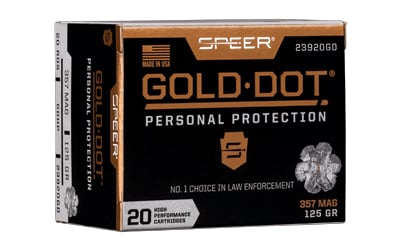
SPR GOLD DOT 357MAG 125GR HP 20/200
Original price was: $50.99.$40.86Current price is: $40.86.
SPR GOLD DOT 357MAG 125GR HP 20/200
Out of stock
This product is currently sold out.
Don't worry! Enter your email and we'll notify you when it's available again.
Description
Speer’s Gold Dot line was built around a straightforward problem with conventional hollow points: the jacket and core separate on impact, which bleeds energy and stops the bullet short of where it needs to go. Speer’s answer was Uni-Cor bonding, a process that electrochemically plates the jacket material onto the lead core one atomic layer at a time rather than pressing or crimping them together. The result is a bullet that holds together through intermediate barriers and still expands consistently because the hollow-point cavity is shaped to initiate reliably across a wide range of conditions — not just bare gelatin.
The 125-grain projectile is driven to 1,450 fps from a 4-inch vented test barrel, producing 584 ft-lbs at the muzzle. That velocity is high enough to drive dependable expansion while the bonded construction keeps the recovered diameter consistent rather than fragmenting. The nickel-plated brass cases make chamber extraction easier in a carry gun and are easy to identify in low-light conditions during a chamber check. Sealed primers guard against moisture intrusion during extended carry — a detail that matters more in a defensive load than in range ammunition.
This is a load designed for the shooter who carries a .357 Magnum revolver and wants the same round that law enforcement agencies have vetted for duty use. It is not a practice load or a target round — the per-box count of 20 reflects its role as carry and qualification ammunition rather than bulk range fodder. Shooters who put significant round counts through a snub-nose should confirm performance from their specific barrel length, since shorter barrels will reduce velocity below the 4-inch test figure.
Additional information
| UPC | 604544647365 |
|---|---|
| Manufacturer | |
| Manufacturer Part Number | 23920GD |
| Bullet Weight (Grains) | 125 |
| Caliber/Gauge | .357 Magnum |
| Case Material | Nickel-Plated Brass |
| Grains | 125Gr |
| Length | 3.1000 |
| Model | Speer Gold Dot |
| Product Type | Gold Dot Hollow Point |
| Shipping Weight | 0.7 |
| Units per Box | 20 |
| Cost per Round | 2.04 |
Related products
-
Sale!
FED AM EAGLE 44MAG 240GR JHP 50/1000
Original price was: $93.99.$74.18Current price is: $74.18. Read more -
Sale!
FED PRM HST 40SW 180GR JHP 20/200
Original price was: $45.99.$37.10Current price is: $37.10. Add to cart -
Sale!
FED HYDRA-SHOK 38+P 129GR HP 20/500
Original price was: $37.99.$30.49Current price is: $30.49. Add to cart -
Sale!
FED CHAMP 32HR MG 95GR LWC 20/500
Original price was: $40.99.$32.97Current price is: $32.97. Add to cart